


The Hidden Connection Between Posture and Disc Pain | RennWellness Andersonville
The Hidden Connection Between Posture and Disc Pain
Posture Is More Than Appearance
When we think about posture, most of us picture sitting up straight to look confident. However, posture isn’t just about appearance, it reflects how your spine functions and the amount of stress your discs endure every day.
Poor posture, particularly in today’s digital age, is one of the most commonly overlooked causes of chronic neck and back pain. When the spine falls out of alignment, your spinal discs absorb abnormal pressure, which accelerates wear and triggers pain, stiffness, or even nerve irritation.
“We see posture as a form of movement hygiene. Every spine tells the story of how a person lives and moves.” – Dr. Todd Renn, DC
Why Posture Matters for a Healthy Spine
The Role of Spinal Discs in Movement
Your spine is made up of 24 movable bones (vertebrae) separated by soft, gel-like cushions called discs. These discs act as shock absorbers, letting you bend and twist without friction. In a healthy, upright posture, weight is evenly distributed through each disc, minimizing strain.
How Poor Posture Damages Discs
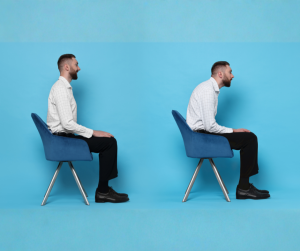 When you slouch or lean forward for long periods, the natural curves of your spine flatten or exaggerate. This uneven positioning increases the load on certain discs particularly in the neck and lower back. Research shows that for every 15 degrees of forward head tilt, the pressure on cervical discs roughly doubles. Over time, this can cause small tears in the outer layer of the disc, leading to bulging or herniation.
Everyday Postural Habits That Stress the Spine
- Desk Posture: Hunching over a laptop or phone rounds the shoulders and compresses the mid-back.
- Phone Neck (“Text Neck” ): Tilting the head forward adds up to 40–60 lbs of stress on cervical discs.
- Driving Posture: Long drives with a rounded back and unsupported headrest flatten natural spinal curves.
- Standing Imbalance: Shifting weight to one side or locking the knees strains lumbar discs and hip stabilizers.
“We live in a forward-dominant world. Every inch the head moves forward adds pounds of stress to your neck and discs.” – Dr. Todd Renn, D.C.
Signs That Posture Is Affecting Your Discs
- Morning stiffness or pain after sitting
- Tingling or numbness in arms, hands, or legs
- Radiating pain into the shoulders, glutes, or thighs
- Fatigue or tightness that worsens at the end of the day
If these symptoms sound familiar, posture may already be compromising your spinal discs.
How Correcting Posture Can Reduce Disc Pain
Decompressing the Spine Naturally

The Role of Movement Screenings
At our Andersonville clinic, we utilize the Selective Functional Movement Assessment (SFMA) to identify dysfunctional movement patterns that contribute to poor posture. This assessment helps us design targeted treatment plans that restore mobility, stability, and symmetry.
Ergonomic and At-Home Tips

- Set screens at eye level to avoid forward head tilt.
- Keep hips slightly above knees with feet flat on the floor.
- Take micro-breaks every 30 minutes: stand, stretch, or walk for 30 seconds.
- Perform daily posture drills: chin tucks, thoracic extensions, shoulder blade squeezes.
- Use lumbar support when driving or sitting for long periods.
When to Seek Professional Help
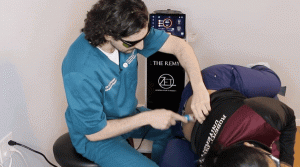 If you experience pain that radiates, lingers after stretching, or worsens over time, it’s time for a professional evaluation. Persistent postural stress may already be affecting your discs or nerves.
At our Andersonville clinic, Dr. Todd Renn, D.C., and his team combine chiropractic care, Non-surgical LaserDisc Decompression™, Regenerative Medical Laser™, and Physical Therapy to restore optimal alignment and disc function.
“You can’t just stretch your way out of a mechanical problem. The spine needs to move the right way again.” – Dr. Todd Renn, DC
Ready to Improve Your Posture and Protect Your Discs?
If you spend hours at a desk, drive long distances, or feel tension in your neck or lower back, start now. A brief assessment can reveal hidden imbalances before they become bigger problems.
Schedule Your Posture & Disc Health Evaluation or Free Consultation
Or call or text (773) 878-7330 to speak with our expert team in Andersonville.
References
Hansraj KK. Assessment of stresses in the cervical spine caused by posture and position of the head. Surgical Technology International. 2014;25:277–279.
Szeto GPY, Straker LM, O’Sullivan PB. A comparison of symptomatic and asymptomatic office workers performing monotonous keyboard work- 1: neck and shoulder muscle recruitment patterns. Manual Therapy. 2005;10(4):270–280.
Claus AP, Hides JA, Moseley GL, Hodges PW. Different ways to balance the spine: subtle changes in sagittal spinal curves affect regional muscle activity. Spine (Phila Pa 1976). 2009;34(6):E208-E214. DOI: 10.1097/BRS.0b013e3181908ead ·
Harrison DE, Colloca CJ, Harrison DD, Janik TJ, Haas JN, Keller TS. Anterior thoracic posture increases thoracolumbar disc loading. European Spine Journal. 2005;14:234-242. DOI: 10.1007/s00586-004-0734-0

Dr. DeFabio D.C. is a highly regarded chiropractor in Chicago who focuses on helping his patients achieve optimal health and wellness. He takes a holistic approach to care, treating symptoms and addressing underlying issues to promote long-term healing. Dr. DeFabio D.C. is passionate about empowering his patients to take control of their health and live their best lives. You can find him surfing, skateboarding, and volunteering at the Lakeview Food Pantry when he’s not in the office.


