


Wrist Pain Treatment Chicago | Ravenswood Chiropractic Andersonville
Wrist Pain
WRIST PAIN TREATMENT IN CHICAGO
Wrist pain from typing, injury, or nerve irritation can build slowly or start suddenly. Understanding what may be driving it is the first step toward moving forward. Wrist pain has a way of sneaking up on people. At first, it might just feel tight or sore after a long day on the computer. Then it shows up when you try to lift something, push yourself up, or grip a weight at the gym. Over time, even simple movements can feel unpredictable.
“A lot of people come in thinking it’s just their wrist,” Dr. Renn says. “But many times, the wrist is just where the stress finally shows up.”
Wrist pain can involve joints, tendons, and nerves working together. While symptom patterns can provide helpful clues, a proper evaluation is needed to understand what is actually driving the issue. At Ravenswood Chiropractic, located on Ravenswood Avenue in the Andersonville neighborhood of Chicago, we look at how your wrist is functioning within the bigger picture so we are not just chasing symptoms.
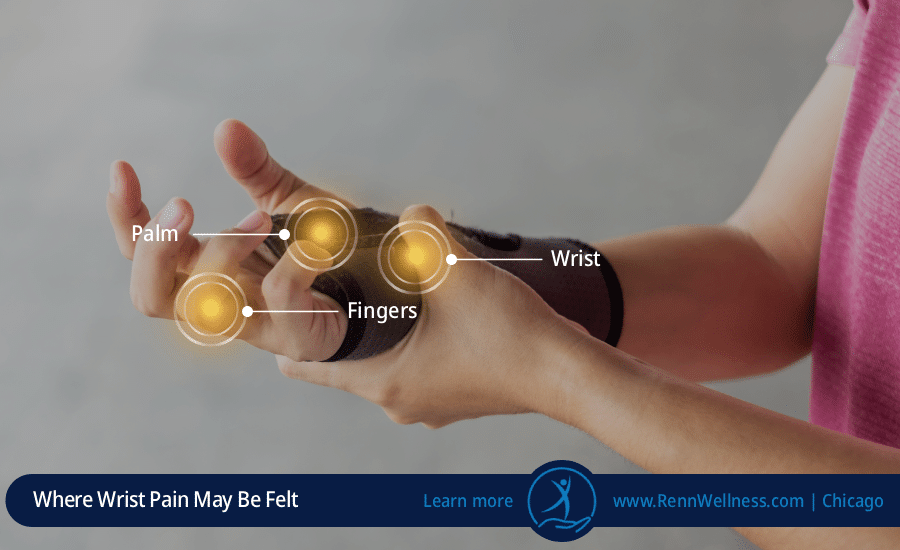
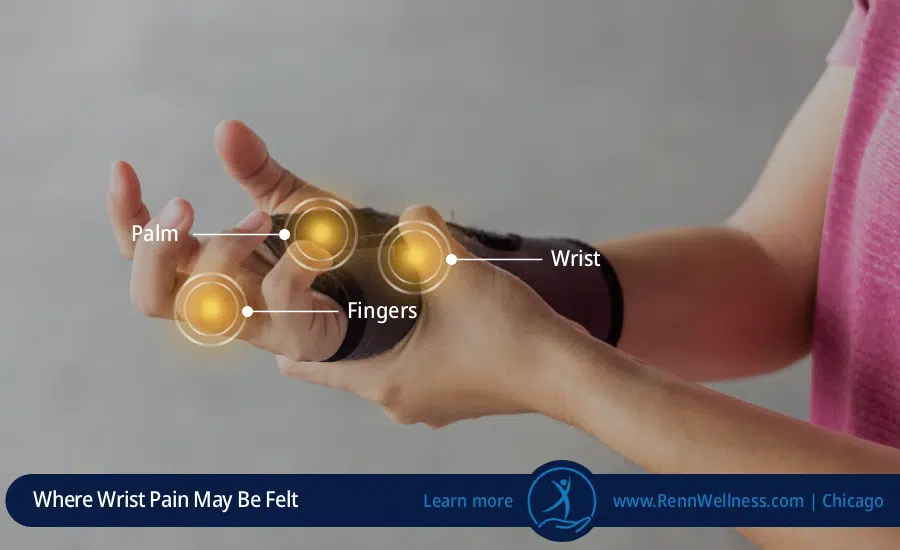
Common Wrist Pain Symptoms
- Wrist pain with gripping objects
- Pain when typing or using mouse
- Numbness in fingers or hand
- Tingling in thumb and index finger
- Weak grip strength or dropping items
- Wrist stiffness in the morning
- Swelling around the wrist joint
- Pain after a fall or impact
- Sharp pain with wrist movement
- Aching with repetitive hand use
- Burning sensation in the wrist
- Limited range of wrist motion
- Pain spreading into forearm
- Clicking or catching in wrist
- Difficulty pushing off with hands
- Symptoms worse at night
These symptoms can overlap between conditions, which is why patterns are helpful, but not definitive on their own.
Not all wrist pain feels the same
If you are trying to make sense of your symptoms, the way it started and how it behaves can offer useful clues.
- Numbness or tingling into certain fingers may be related to nerve irritation such as carpal tunnel
- Pain after a fall or sudden movement may fit a wrist sprain or strain pattern
- Gradual soreness with typing or repetitive use often reflects overuse or repetitive strain
- Stiffness or aching, especially in the morning, may be associated with joint irritation or arthritis
Wrist pain can show up in different ways, and similar symptoms can have different causes. The categories above reflect common patterns we evaluate, not a diagnosis on their own.
“The pattern matters,” Dr. Renn explains. “How it started and how it behaves tells us a lot about what’s going on.”
Why wrist pain is not always just a wrist problem
The wrist is a small joint, and it depends on everything around it. Muscles in your forearm control movement. Nerves travel from your neck down into your hand. Your elbow and shoulder help distribute load when you push, pull, or grip. When something along that chain is not working as it should, the wrist often ends up taking more stress than it should.
“If the wrist is doing more than its share of the work, it eventually lets you know,” – Dr. Renn, D.C.
What wrist pain may be related to
Wrist pain can come from several different sources, sometimes at the same time.
- Carpal tunnel or nerve irritation
- Wrist sprains and strains
- Repetitive strain from work or activity
- Tendon irritation from overuse
- Arthritis or joint stiffness
These are common patterns we evaluate, but an exam helps determine what is most relevant in your situation.
Wrist pain from typing, work, and everyday use
A large percentage of wrist pain we see in our office does not come from a single injury. It builds gradually. Typing, scrolling, gripping tools, lifting weights, or repeating the same motion throughout the day can place small amounts of stress on the wrist over and over again.
“People are often surprised that nothing dramatic happened,” Dr. Renn says. “It’s usually repetition catching up with them.”
Wrist pain after a fall, workout, or sudden movement
If your wrist pain started suddenly, especially after a fall or awkward movement, it is worth paying attention to. Even injuries that seem minor at first can linger if normal movement and strength do not fully return.
Numbness, tingling, or weakness in the hand
When these symptoms include tingling, numbness, or reduced grip strength, the nervous system may be involved. Carpal tunnel is one possibility, but it is not the only one.
Wrist stiffness, swelling, and arthritis
Some wrist pain develops more gradually and feels more like stiffness than sharp pain. It may be more noticeable in the morning or after periods of inactivity.
When to get wrist pain evaluated
If you’re unsure what’s causing your symptoms, it’s reasonable to have them evaluated rather than guessing based on symptoms alone.
You should consider an evaluation if:
- Pain is not improving after several days
- You are having trouble gripping or using your hand
- Symptoms are affecting work, workouts, or sleep
- Pain started after a fall or sudden movement
Red flags: When You Should Consider Urgent Care
- Significant swelling or visible deformity
- Severe pain immediately after injury
- Inability to move or support weight through wrist
- Worsening numbness, tingling, or weakness
- Loss of coordination or control in the hand
“If something feels off, it’s better to check it early,” Dr. Renn says.
How we evaluate wrist pain
- Review how symptoms started and daily activity patterns
- Assess wrist movement and joint function
- Check grip strength and hand control
- Screen for nerve-related symptoms
- Evaluate forearm, elbow, and shoulder mechanics
Dr. Renn evaluates wrist pain by looking at how the joint, surrounding muscles, and nerve pathways are functioning together, rather than focusing on just one structure.
Treatment options
Treatment recommendations depend on what is found during the evaluation, how symptoms are behaving, and whether additional testing or referral is appropriate.
Chiropractic and joint support
Improving how the wrist and surrounding joints move can reduce unnecessary stress.
Physical Therapy
Targeting muscles and tendons can help restore more natural movement patterns.
Class IV Laser Therapy
Used to support tissue healing and calm irritated areas.
Shockwave Therapy
Sometimes used for more persistent tendon-related irritation.
Activity and ergonomic guidance
Small changes in positioning and movement can reduce repetitive stress.
What improvement may look like
Most of our patients notice that everyday movements feel easier and less irritating over time. Our goal is to improve how the wrist functions so activities become more comfortable and predictable again.
Wrist Pain FAQ
Can a chiropractor help with wrist pain?
In many cases, yes. Wrist pain often involves joint function, movement patterns, and repetitive stress, all of which can be evaluated conservatively.
Why does my wrist hurt when I type?
Typing can place repeated stress on the wrist and forearm. Over time, this can irritate tendons or nerves depending on positioning and use.
What is the difference between carpal tunnel and a wrist strain?
Carpal tunnel typically involves nerve-related symptoms like numbness or tingling, while strains involve muscles or tendons and often present as pain with movement.
Can wrist pain come from somewhere else?
Yes. The wrist is connected to the forearm, elbow, and neck, and problems in those areas can contribute to symptoms.
Do you treat wrist pain near Andersonville?
Yes. Ravenswood Chiropractic is located in Andersonville and serves surrounding Chicago neighborhoods.
Final Note
Wrist pain can seem simple on the surface, but it often involves more than one factor.
“If it’s not improving the way you expected, there’s usually a reason,” Dr. Renn says. “That’s what we try to figure out.”
Disclaimer
This information is intended for educational purposes and is not a substitute for an individual evaluation or medical advice.


