


Lower Leg Pain Treatment Chicago | Shin Splints, Stress Fractures & Calf Pain
Leg Pain
Lower Leg Pain Treatment in Chicago
Shin Splints, Stress Fractures, and Calf Pain Explained
Lower leg pain is one of those things that seems straightforward until it isn’t. Most people naturally focus on the spot that hurts. The shin, the calf, maybe the outside of the leg. That makes sense. But what we often see in the clinic is something a little different. The lower leg is usually where the problem shows up… not always where it starts. Every step you take involves force moving through your body from your spine, through your hips, into your knee, and down into the lower leg and foot. When that system is working well, the load is shared. When it’s not, something has to pick up the difference. A lot of the time, that “something” ends up being the lower leg. At Ravenswood Chiropractic in Andersonville, we spend a lot of time helping people understand why that happens and what needs to change so it doesn’t keep happening.
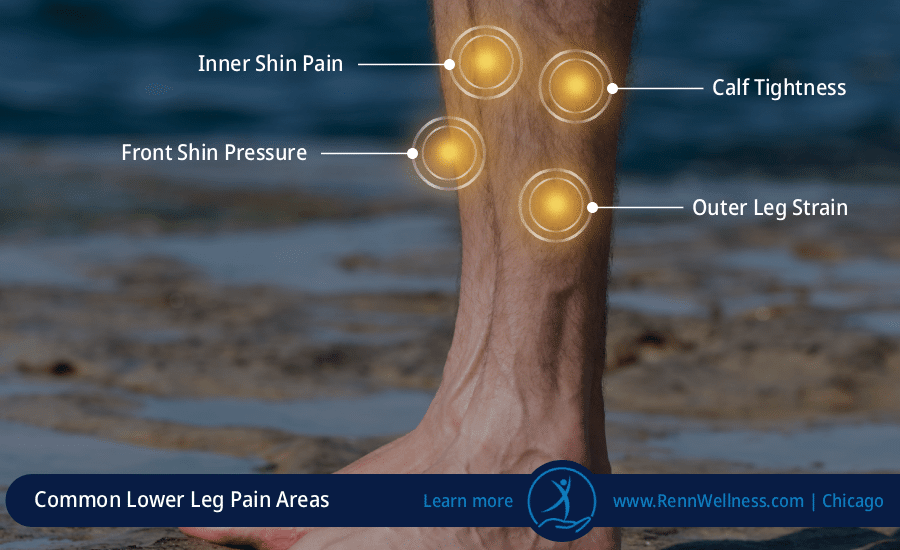
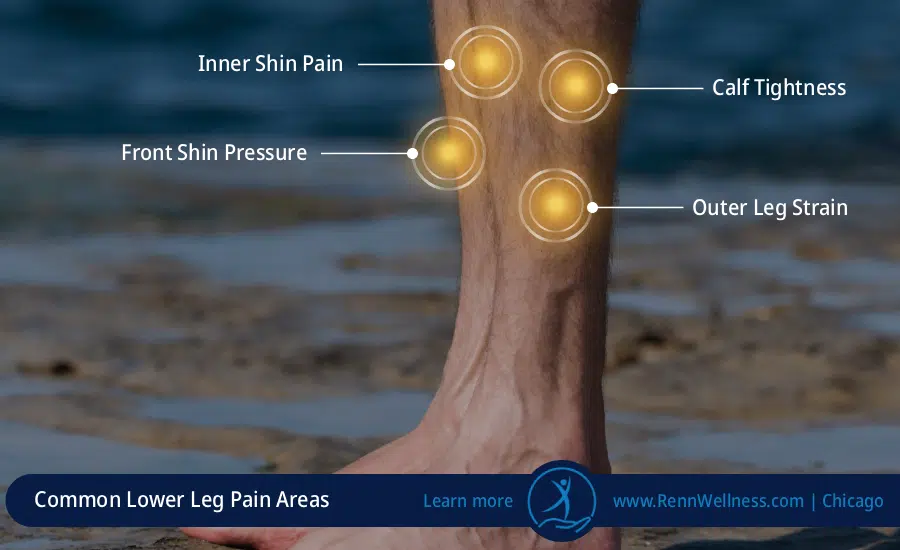
Why Lower Leg Pain Is Often Not Just About the Leg
The tibia is strong. It’s built to handle repeated force. But it’s not meant to do it alone. When the system above and below it isn’t sharing the work well, the lower leg quietly absorbs more stress than it should. That doesn’t usually show up all at once. It builds. A little more load here. A little less support there. Until something starts to feel off. What we commonly see is one or more of the following:
- Hip movement that isn’t absorbing force efficiently
- Fatigue in the calf reducing shock absorption
- Subtle changes in walking or running patterns
- Uneven distribution of load through the foot
Over time, the lower leg becomes the place where that stress accumulates.
Common Causes of Lower Leg Pain
Lower leg pain is a category, and the details matter.
Shin Splints (Medial Tibial Stress Syndrome)
This is one of the most common patterns. It usually shows up as a dull, spreading ache along the inside of the shin, especially with activity.
Read more about Shin Splints
Stress Fractures (Bone Stress Injuries)
This is where the conversation changes a bit. Instead of soft tissue irritation, the bone itself starts to struggle with repeated stress faster than it can adapt. Pain tends to become more specific over time.
Calf Strain and Muscle Overload
The calf plays a major role in absorbing and controlling force. When it’s overworked or compensating it can tighten, fatigue, or strain. Sometimes repeatedly.
Other Considerations
Less common, but still important:
- Tendon irritation
- Nerve-related symptoms
- Compartment-related pressure issues
Part of our job during the evaluation is to sort out which pattern you’re actually dealing with.
Why Lower Leg Pain Keeps Coming Back
This is one of the most common frustrations. You rest. It improves. You go back to normal activity… and it comes back. That pattern usually tells us something important: The environment hasn’t changed. The same load is still moving through the same system in the same way. So even though symptoms settle temporarily, the underlying issue is still there. That’s why we focus less on chasing pain and more on changing how your body handles stress.
The Spine-Hip-Leg Connection
Here’s something most people are never really told: The lower leg is downstream. If the hip isn’t doing its job, the lower leg picks up the slack. If the spine isn’t stable, force transfer becomes less efficient. If coordination is off, tissues fatigue faster. So while the pain is real in the shin or calf, the reason it showed up there is often part of a bigger picture. When that system improves, the lower leg usually stops being overloaded.
How We Approach Lower Leg Pain at Ravenswood Chiropractic
Our goal is not just to calm symptoms. It’s to help your body handle load more efficiently moving forward.
1. Movement and Load Assessment
We look at how force is moving not just where it hurts.
2. Class IV Laser Therapy
Used to support:
- Tissue recovery
- Inflammation regulation
- Cellular activity
3. Shockwave Therapy
Shockwave is often used when healing has slowed or stalled.
It may help support:
- Local circulation
- Tissue response
- The body’s natural repair processes
It’s not a standalone solution but it can be a useful part of a broader plan.
4. Strength, Stability, and Return to Activity
We guide patients through:
- Rebuilding tolerance
- Improving movement patterns
- Gradual return to activity
When Should Lower Leg Pain Be Evaluated?
Some symptoms are worth checking sooner rather than later.
- Pain that becomes more localized
- Pain that continues to return
- Difficulty with walking, running, or pushing off
- Symptoms not improving as expected
Not every case is serious but some require a closer look to rule out more significant issues. If pain becomes sharp, very localized, or affects your ability to bear weight, it should be evaluated promptly to rule out more significant injury.
Lower Leg Pain Treatment in Andersonville, Chicago
We work with patients across Andersonville and nearby Chicago neighborhoods who are dealing with lower leg pain that hasn’t fully resolved. Many have already tried resting, stretching, or modifying activity. Our role is to help you understand what’s happening and what needs to change for it to improve.
Frequently Asked Questions
Is lower leg pain always shin splints?
No. Shin splints are common, but similar symptoms can come from bone stress, muscle strain, or movement-related overload.
Can lower leg pain come from the hip or back?
Yes. The way force moves through the body can shift stress into the lower leg.
How do I know if it’s a stress fracture?
Stress fractures tend to become more localized and persistent. If symptoms are worsening or not improving, evaluation is recommended.
Does rest fix lower leg pain?
Rest can reduce symptoms, but it doesn’t always change the underlying cause.
What treatments may help lower leg pain?
Treatment depends on the cause. Supporting tissue recovery and improving movement patterns are often part of the process.


