
5 Things You Can Do to Treat or Prevent DOMS
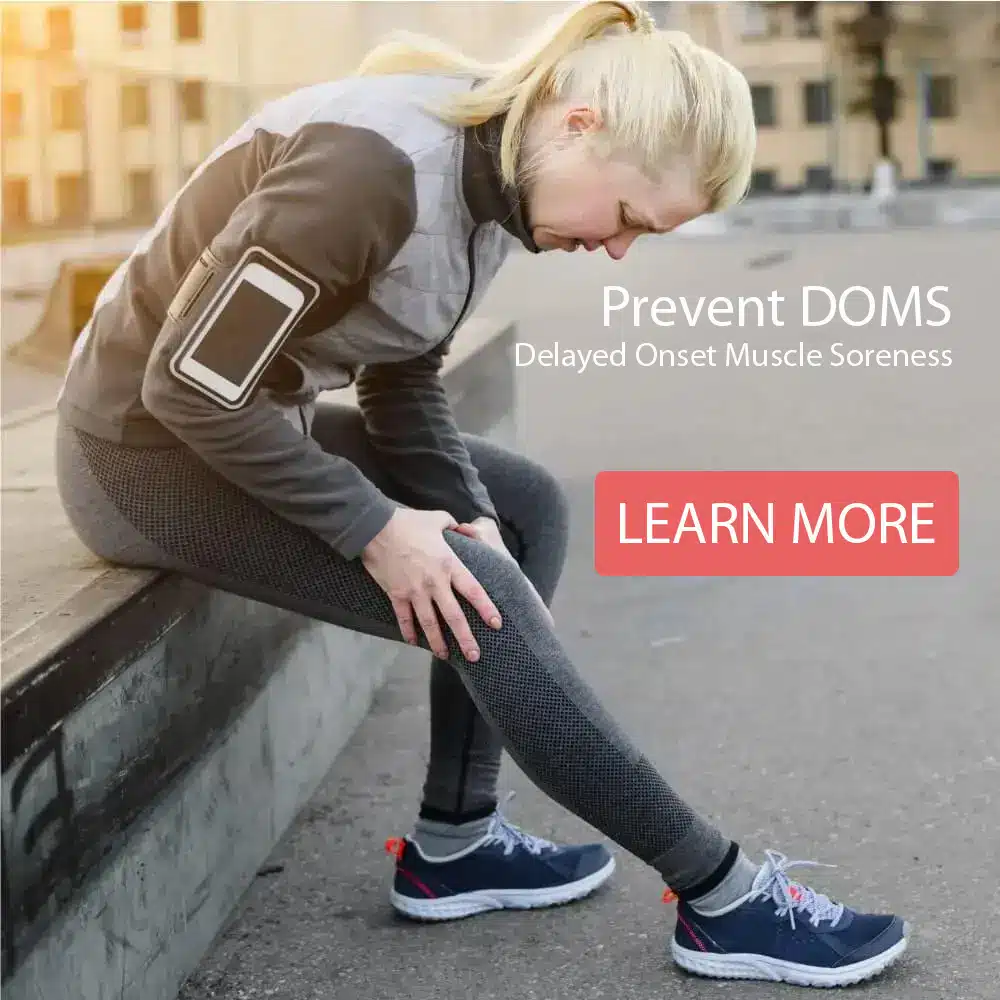
The term “DOMS” stands for Delayed Onset Muscle Soreness. It occurs gradually after exercise and is felt as stiffness and mild pain. DOMS usually goes away 48 hours after your activity as your muscles heal. But you can do things to reduce the pain and speed recovery. DOMS is usually a normal response to increased activity levels that lead to microscopic tearing of your muscle fibers. Contracting our muscles while they lengthen is the most common cause of these tears. This is a normal response and how greater strength is built by your muscles.
The good news: DOMS is usually temporary.
The even better news: there are several ways to help reduce how sore you feel and support recovery so that you can return to training and daily life more comfortably.
Note: Not every “sore muscle” is DOMS. If you have sharp or sudden pain, swelling, bruising, numbness/tingling, marked weakness, pain that worsens after 72 hours, or you cannot use the area normally, it is smart to get evaluated by a qualified healthcare practitioner.
Are you ready to recover from post-workout soreness?
At RennWellness, we understand the challenges that athletes and fitness enthusiasts face after an intense workout, and we’re here to help. Our expert team offers sports medicine-informed recovery plans tailored to your specific needs.
Many of our patients want something that fits into a busy schedule, especially athletes in-season, runners training for an event, or weekend warriors trying to function at work the next day.
Class IV Laser Therapy for DOMS
 One of the advanced therapies we provide is Class IV laser therapy. This non-invasive treatment utilizes specific wavelengths of light to penetrate deeply into tissues. By increasing circulation, it delivers vital oxygen and nutrients to sore muscles while aiding in the removal of metabolic waste. This stimulation of cellular activity promotes faster tissue repair, reduces inflammation, and inhibits pain signals, making it an effective solution for those dealing with Delayed Onset Muscle Soreness (DOMS).
Shockwave Therapy For Sore Muscles
 In addition to laser therapy, we also offer shockwave therapy. This innovative treatment uses high-energy acoustic waves to target sore muscles directly. By enhancing blood flow and stimulating cellular repair, shockwave therapy not only alleviates pain but also helps break down scar tissue and promote collagen production. This accelerates the recovery process, allowing you to bounce back quicker and perform at your best.
Don’t let muscle soreness hold you back
Contact us today to learn more about our comprehensive recovery strategies and schedule your appointment at RennWellness. Together, we can help you get back to doing what you love!
What to expect at your first appointment
 An exam and brief check-in on your training, symptoms, and goals and proposed treatment plan
- Targeted treatment to the most affected areas
- Guidance on what to do the next 24-72 hours (movement, load management, recovery)
DOMS vs. Injury: when to get checked
Consider an evaluation if you have:
- Sharp pain or a pop during activity
- Significant swelling or bruising
- Pain that worsens over time
- Numbness or tingling
- Trouble bearing weight or using the limb normally
- Symptoms that are not improving after several days
A sports medicine-informed assessment can help confirm whether this is straightforward DOMS or something that needs a different plan.
 Dr. Renn is certified in Selective Functional Movement Assessment (SFMA), a specialized approach that helps identify movement pattern dysfunctions and physical limitations in athletes. By using SFMA, Dr. Renn can assess how an athlete performs functional movements and pinpoint any areas of pain or weakness that may impact performance. This comprehensive evaluation enables tailored treatment plans that address specific needs, helping athletes improve movement efficiency, reduce injury risk, and enhance overall performance in their sport.
DOMS recovery at Ravenswood Chiropractic in Chicago
At Ravenswood Chiropractic and Chicago Laser Pain Center in Andersonville, we take a sports medicine approach: understand your training, identify what is driving symptoms, and match the right recovery strategy.
If you want a quick, non-invasive in-office option, we offer the following if it is appropriate for you:
Other ways that you can help prevent DOMS


Stretch Before Exercise
Stretching before exercise helps prevent injury by loosening up tight muscles.
If you want to reduce the pain associated with DOMS, consider stretching before exercising. Stretching helps muscles lengthen and relax, which reduces tension and improves blood flow. You should stretch large and small muscle groups, such as hamstrings, quadriceps, calves, glutes, and shoulders.
Stretching should include a good Warm Up.
A warm-up is an essential part of any workout routine. It prepares your body for exercise by increasing muscle temperature, improving circulation, and reducing stiffness. In addition, warming up also allows you to perform at your peak level during your workout.
TIP: If you want to reduce the pain associated with DOMS, start with dynamic exercises first. These exercises use large muscle groups and require more energy than static ones. They also help improve blood flow and oxygenation throughout the body.
Avoid Overuse | Take Time Off Exercising
It’s not uncommon for people who exercise regularly to feel DOMS. While some people experience DOMS right away, others may notice it later. If you want to improve your performance, you need to make sure you recover properly after each workout. That means taking breaks between workouts and resting enough before you start again. It also means ensuring you eat well and drink plenty of water during your recovery period. Learn more about Nutrition For the Female Athlete and Nutrition For the Male Athlete.
While rest days are essential, they aren’t the only thing that affects recovery. Some people who train too much end up with worse DOMS than those who train less often. This is because when you exercise, your body produces cytokines that cause inflammation. Cytokines are produced by immune cells, which fight off infections and other harmful substances. However, when you exercise too frequently, your body can release too many cytokines at once, causing inflammation.
Drink Water Before Exercise
It’s not easy to forget to drink water during exercise because we often feel thirsty. However, drinking enough water before will help keep you hydrated and reduce muscle cramps. Try drinking at least 16 ounces (1 cup) of water every 30 minutes during exercise. Visit our article on hydration for athletes for more detailed information.
FAQ
How long does DOMS last?
DOMS often peaks around 24-72 hours after a workout and then gradually improves. The timeline can vary based on training intensity, novelty, sleep, and overall recovery habits.
Is it okay to work out with DOMS?
Often, yes, if symptoms are mild and you can move with good form. Many athletes do light training or active recovery (easy cardio, technique work, mobility). If pain is sharp, changes your mechanics, or is getting worse, consider reducing load and getting evaluated.
What helps DOMS the fastest?
There is no single guaranteed fastest fix. Many people feel best with a combination of light movement, adequate sleep, hydration, and smart nutrition. If you want a quick in-office option, a Class IV laser may be a good fit for some people, and shockwave may be considered in select cases.
Does stretching get rid of DOMS?
Stretching may help you feel looser and improve comfort, especially after a warm-up, but it may not eliminate DOMS on its own. Gentle mobility plus load management is often more helpful than aggressive stretching.
Does lactic acid cause DOMS?
Next-day soreness is not usually caused by lactic acid. DOMS is more associated with training stress, tissue response, and the body’s recovery process.
When should I be concerned it is not DOMS?
Seek evaluation if you have swelling, bruising, sharp pain, a pop during exercise, numbness or tingling, marked weakness, inability to bear weight, or symptoms that worsen or do not improve after several days.
Do you offer sports massage at RennWellness?
We no longer provide massage therapy. Sports massage can still be a helpful recovery tool, and we are happy to refer you to therapists we work with. At RennWellness, our quick-recovery-focused options include Class IV laser and, when appropriate, shockwave therapy as part of a sports medicine-informed plan.
Educational disclaimer: This article is for general education and is not medical advice. Results vary by individual, training load, and health history.

Meet Carlos Matos L.M.T., a licensed massage therapist in Chicago with over 10 years of experience. Carlos L.M.T. specializes in deep tissue massage, sports massage, and myofascial release therapy. He is passionate about helping his clients achieve optimal health and wellness through customized massage treatments that target their specific needs. Carlos L.M.T. believes that regular massage therapy can improve both physical and mental well-being, and he takes pride in providing a safe and comfortable environment for his patients to relax and heal.


